SEO strategies for RIAs: How to improve your website's ranking

Key Points
-
- Search engines crawl websites to judge quality and relevance. Keep pages accurate, easy to navigate, and quick to load to rate higher.
-
- Keywords still matter. Think about the words prospects type in search and what sets your firm apart, then work those words into your website in a natural way.
-
- Artificial intelligence (AI) is changing search quickly. Create plain-speak FAQs to help your page get included in AI summaries.
According to the search marketing agency Reboot, there are more than 1.1 billion websites in the world.1 For registered independent advisor (RIA) firms, getting found online can feel like a "one in a billion" chance. That's where search engine optimization (SEO) comes in.
SEO is how you improve the chances your website shows up when a prospect searches online for a financial advisor like you. By carefully choosing the words you use, organizing pages and information clearly, and building credibility, you can move your site higher in search rankings.
SEO is about progress, not perfection. The sooner you start, the sooner your website can rise in the ranks. So, let's kick off by looking at how search works.
Getting to know SEO
Search engines use automated "crawlers" to scan and index your website. Think of a crawler like a stand-in for a real visitor. It looks for keywords and other indicators of content quality like:
- Simple navigation
- Well-organized webpages
- Clear communication
- Easy-to-follow, conversational tone
- Accurate and useful information
In the early days, SEO was mostly a keyword game. Keywords are words or phrases that people frequently use in a search. Earlier versions of search engines simply scoured websites looking for exact matches.
Today, search engines are much smarter. Keywords still matter, but quality of content matters more. Google's SEO fundamentals tutorial suggests that pages be "designed to prioritize helpful, reliable information that's created to benefit people, and not content that's created to manipulate search engine rankings."2
Search engines also pay attention to your reputation beyond your website. They look at how often other high-ranking sites link to yours and track credible mentions of your firm in videos, news stories, and other online content.
All of this info is used by search engines to rank sites and display them in a specific order when a person types in search terms. This is why the quality of the keywords, links to your website, and firm mentions matter so much. It's also why you want to make sure not to get on the wrong side of a search engine.
SEO fails that can significantly damage your search rankings include:
- Keyword stuffing: Unnaturally and unhelpfully cramming popular words or phrases onto a page.
- Link spam: Plastering pages with links, whether they are useful or not.
- Manufactured mentions: Creating dummy websites to increase their mentions.
What search sees

SEO starters: Tackling the low-hanging fruit
The strategy for search engine success is simple: Create a site with genuinely useful content for the people you (want to) work with. You don't need a full website overhaul to start. Here are a few moves you can make right now.
Master keywords
The words on your site still matter—a lot. Prioritize keywords that your ideal client uses when searching for an advisor. Start with basic terms ("financial advisor," "wealth management," and "investment advice"), then get specific with what makes your firm the right fit (e.g., "tax-aware investing" or "financial planning for executives"). The goal is to "match" what your ideal client is searching for. But remember, forcing keywords does more harm than good, so make sure keywords read naturally and make sense within the context of the page.
Focus on your industry and expertise
Ask yourself: What do we do best and who do we do it for? Answering these questions can lead you to your strongest search terms. An easy way to start brainstorming is to ask your clients what they'd search to find you. You can also use online keyword research tools such as Google Keyword Planner or Moz Keyword Explorer to see common search terms. Or you can type "financial advisor in (your city)" and see what Google suggests and which of your competitors' sites show up.
Develop longer keyword phrases
Compare "Financial advisor" with something more specific, like "Personalized retirement advice for Houston business owners." The broader term gets more searches, but you're competing against every site using the exact same keywords. The more specific keyword phrase gets fewer searches, but you're more likely to rank higher in those searches and attract more qualified prospects.
Note: Your phrase doesn't need to match a prospect's search word for word. Search engines are smart enough to interpret variations.
Selectively add keywords
Be choosy: Use words and phrases that reflect the page content and fit in naturally. High-impact spots for keywords include the page title, description, page headlines, first 150 words of content, and link text because this is what crawlers focus on most.
And don't forget the meta title and meta description, which show up on a search results page. These can be different from your article title and intro, but you may need to work with a website developer to make that happen.
Think local
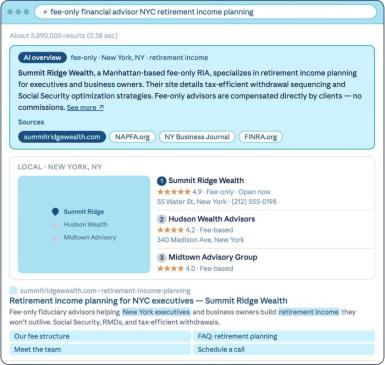
Most prospects want to work with financial advisors in their community. That's one reason it's important to show up in searches that include your city or state. On desktop and mobile, local searches often show a map with nearby businesses, phone numbers, and websites. Make sure these contact details are easy to find on your website to put your firm on the map (literally).
Sign up for local business listings
Many search engines offer free local business listings, such as Google Business Profile and Bing Places for Business. In Google, completing your business listing and keeping it accurate, detailed, and up to date can land your business in the coveted "Places" directory that appears at the top of local search results.
Describe your firm
Make it clear who you are, what you do, and where you do it. Your "home" or "about" pages are great places for this. A simple, direct description makes it easy for prospects and search engines to understand what your firm is about. Just make sure you don't repeat the same copy on multiple pages. Search engines might treat duplicated copy as lower quality and dock your page ranking.
Next-level SEO
Once you've tackled the low-hanging fruit, it's time to improve the overall experience. How can you make your site more interesting and useful to your audience?
Simplify navigation
Strong sites have a naturally flowing structure with broad, high-level pages (like "Services") that link to more specific pages (like "Retirement Planning"). Ask yourself: Can new visitors find information easily? Do the link labels make sense? If you're not sure, ask clients for their two cents.
Confusing navigation is worth fixing and likely won't require rebuilding your website. Relabeling and reorganizing often does the trick.
Optimize for mobile
A big share of searches happen on phones. Search engines reward sites that load fast, display well on smartphones and tablets, and make it easy to find key information. Pop-ups, broken links, complicated menus, or duplicate content can drag your site ranking down. If your site isn't optimized for mobile, work with your developer to make it a priority for the next redesign. Use tools like Google Search Console and PageSpeed Insights to see how your site is doing on mobile.
Advertise
Visibility doesn't only come from your website. Credibility is built when your firm shows up in trusted advertising, news articles, videos, or interviews. This credibility feeds into brand authority rankings which help support SEO.
Submit your sitemap
After you've updated your site, ask your developer to submit a sitemap to Google. A sitemap is a map of your website that helps crawlers find and index your pages. If your site is logical and easy to follow, crawlers probably won't have too much trouble, but it never hurts to be thorough.
Keep your site fresh
Your site probably has "evergreen" pages (aka pages that don't change often), such as your investment philosophy, team bios, and "contact us" pages. To keep building SEO, add fresh content that answers specific questions prospects ask. Search is designed to answer questions, so if your site includes relevant questions and answers, it's more likely to rank higher in search results. In fact, FAQs can significantly boost the effectiveness of your site's search.
Tips for keeping content fresh:
- Write what you know. Your expertise is what clients and prospects need. Turn real questions into clear answers to become a go-to place for information.
- Start small. You can't do it all—and that's okay. Maintaining an active website communicates that real people who care are behind this firm.
- Share on social media. Don't just post on your website. Share content where your clients (and prospects) are. Building a presence on LinkedIn, Facebook, and "X" (formerly Twitter) can help you establish loyal followers who look forward to your content.
- Remove or update outdated material. Blog posts like "Tax Tips for 2023" or "Estate Planning for 2021" are no longer relevant for users and could damage your search rankings. If you don't remove them, refresh them each new year or rewrite them to be evergreen.
What strong optimization looks like
How is AI changing search?
Search is changing fast. Nearly every search engine now includes artificial intelligence (AI) summaries at the top of search results, often merging content from multiple sources. Links to the source pages are included, so while many searchers may stop at the AI summary, serious prospects are likely to click through to your site.
Many firms are now also optimizing their website for AI search. At a basic level, Answer Engine Optimization (AEO) is a lot like SEO but the goal is slightly different; you're formatting your content so an AI tool can pull a short, accurate answer from your page. Here are a few AEO tips:
- Provide extractable answers. AI wants clean, direct answers it can pull and reproduce for searchers. If a paragraph clearly answers a real question, your answer (and website) is likely to appear when that question is searched. This is one reason FAQs are now even more important for search.
- Get mentioned by credible sources. AI wants to serve up answers from the most trusted sources. If your firm can get mentioned in news reports, on TV shows, and by well-known financial figures, your brand credibility gets a boost and your odds of showing up in an AI answer increases.
- Show the depth of your expertise. Publishing content isn't enough anymore. AI search is looking for specific, useful guidance that shows real experience (not just the same expertise that can be found elsewhere).
What to expect from your SEO efforts
SEO is a long game. It could take months or even years for your efforts to make a major difference. Search engines don't see changes instantly and need time to trust new or improved content. You're also competing with other financial advisors online, some of whom are likely investing in SEO too.
Don't let any of that get you down. What matters is progress. Pick a couple of improvements to try this month, then build from there. Over time, small moves can make a big difference.
What you can do next
- Turn messaging vibes into marketing strategy From refining your value proposition to attracting your ideal client, explore Schwab's resources.
- Curious about how Schwab helps RIAs? Wealth services, technology, and business support are just the beginning. Whether you're exploring independence or considering a custodian swap, we're here to help you take your next step.
1 "Website Statistics Report 2026," Reboot, https://www.rebootonline.com/website-statistics.
2 "Creating helpful, reliable, people-first content," Google Search Central, https://developers.google.com/search/docs/fundamentals/creating-helpful-content.