Stocks Slip Early After Wholesale Inflation Surges

Published as of: October 15, 2026, 9:22 a.m. ET
Listen to this article
Listen here or subscribe to the Schwab Market Update in your favorite podcast app.
| The markets | Last price | Change | % change |
|---|---|---|---|
| S&P 500® Index | 7,718.94 | -86.51 | -1.11% |
| Dow Jones Industrial Average® | 51,621.48 | -48.62 | -0.09% |
| Nasdaq Composite® | 26,692.87 | -511.51 | -1.88% |
| 10-year Treasury yield | 5.06% | -0.13 | -- |
| U.S. Dollar Index | 102.10 | -0.44 | -0.43% |
| Cboe Volatility Index® | 17.50 | +0.63 | +3.73% |
| Gold | $4,168.50 | +$60.20 | +1.43% |
| WTI Crude Oil | $95.18 | +$0.09 | +0.11% |
| Bitcoin | $80,745 | -$1,080 | -1.26% |
(Thursday market open) U.S. wholesale prices surged 0.7% last month for the core Producer Price Index (PPI) excluding food and energy, well above expectations of 0.3% and the most dramatic rise in four years. Monthly headline PPI, which includes energy, soared 1.3%, the second most in history. Major indexes were already lower and dipped further on the news, but Treasury yields maintained their surprising and dramatic early losses in what appeared to be a flight to perceived "safety" amid geopolitical tension.
"Energy continues to be the main culprit, but even stripping that away, annual core PPI was up 5%," said Cooper Howard, director of fixed income research and strategy at the Schwab Center for Financial Research (SCFR). "A risk is that higher diesel and energy prices begin to bleed into other categories, and this suggests that's the case. For the Fed, this report, combined with CPI, raises the odds of a rate hike in October. We expect two more hikes this cycle depending on the pace and breadth of inflation."
The rate-driven sell-off in AI-related names continued this morning after six straight lower sessions for chip stocks. There's widespread concern that higher borrowing costs could slow the data center buildout, and those worries got reinforced by yesterday's hot Consumer Price Index (CPI). Chip stocks fell another 4% Wednesday and entered correction territory with the PHLX Semiconductor Index (SOX) down more than 10% from last week's peak. Major indexes dropped Wednesday, most sharply for the tech-exposed Nasdaq.
To get the Schwab Market Update in your inbox every morning, subscribe on Schwab.com.
Three things to watch
- PPI deeper dive: Checking annual PPI growth, a sizzling 6.3% rise in the headline number compared with expectations for 5.3%. Core annual PPI of 5% compared with expectations of 4.4%. Under the hood, it seems likely that elevated energy costs are flowing into other categories, especially airfares as airlines grapple with rising diesel costs. Both CPI and PPI could factor into the September Personal Consumption Expenditures (PCE) prices report, the Fed's favored inflation meter, due later this month. For PPI metrics that map over to PCE, airfares were the standout, increasing 5% month over month. The PPI report is different from CPI, in part because CPI weighs shelter costs higher. These differences can make PCE a deciding factor for the Federal Reserve, but not this time as PCE data arrives October 29, a day after the next Fed decision. The jobs picture also affects rate decisions, but that data arrives the week after the meeting. So does the November mid-term election, but that's unlikely to prevent a rate hike if the Fed thinks it's necessary. Separately, the Fed got more news of a hot economy today as September retail sales growth of 0.8% easily outpaced expectations of 0.3%.
- Yields drop as AI infrastructure and chip names sell off: The 10-year Treasury note yield plunged nine basis points this morning to just under 5.1%, the lowest since September 24, despite Wednesday's sharper-than-expected CPI increase. This is a dramatic move—the sharpest decline since June—after it reached almost 5.33% early yesterday. The sudden rise in Treasuries, which move opposite of yields, could hint at more defensive trading as geopolitical tensions build and the U.S. election approaches. Worst hit in the AI sector yesterday was data center builder CoreWeave (CRWV), down double-digits, and cloud giant Oracle (ORCL). CoreWeave—a data center builder—fell another 3.6% early today. In a letter to staff obtained by Bloomberg, CoreWeave's CEO said there are times "when the market misunderstands and acts irrationally." This followed a sell-off in the company's bonds. Deutcshe Bank today maintained its buy rating on CoreWeave. Other AI stocks losing the most ground this morning included SK Hynix (SKHY), Western Digital (WDC), Seagate (STX), Applied Digital (APLD), Micron (MU), and Sandisk (SNDK), all down 4% or more.
- Bank earnings wrap: With yesterday's results from Bank of America (BAC) and Morgan Stanley (MS), all the major Wall Street banks have now reported third quarter earnings. It was a mixed bag, as Bank of America and JPMorgan Chase (JPM) both missed analysts' expectations. Bond trading weakness last quarter hurt that side of the business for many big banks, which analysts had anticipated. Still, bank earnings reinforced ideas that the underlying consumer and business economy isn't struggling. Loan growth looked solid and credit concerns didn't surface. Big banks didn't add much protection against possible credit defaults, a sign they don't anticipate turbulence despite current high borrowing costs. Investment banking suffered as some prominent firms postponed initial public offerings (IPO) in the tighter financial environment. That didn't prevent Goldman Sachs (GS) from offering positive comments on the earnings call. "Capital markets activity is still good," CEO David Solomon said. "I think we're still in a very good capital markets environment. The IPO market is still in pretty good shape."
Crypto currents
End of "crypto winter" opens door to macro headwinds: Investment flows, leverage, sentiment... Nearly every indicator points to improved investor demand and participation in crypto markets, as reflected in bitcoin's rally of about 40% from the bear market lows hit in June, said Jim Ferraioli, director of digital currencies research and strategy at SCFR. The takeaway is clear: "Crypto winter" is over. With the extreme fear and aggressive deleveraging of the bear market having passed, bitcoin and other crypto assets are likely to be more affected by the macro environment than earlier in the year, trading more like low correlation risk assets, Ferraioli said. This may leave them more exposed to risk-off episodes. Exhibit A is bitcoin's drop in reaction to Wednesday's hotter-than-expected inflation data. The prospect of rising interest rates ahead could create headwinds for crypto in the months ahead.
" id="body_disclosure--media_disclosure--334126" >End of "crypto winter" opens door to macro headwinds: Investment flows, leverage, sentiment... Nearly every indicator points to improved investor demand and participation in crypto markets, as reflected in bitcoin's rally of about 40% from the bear market lows hit in June, said Jim Ferraioli, director of digital currencies research and strategy at SCFR. The takeaway is clear: "Crypto winter" is over. With the extreme fear and aggressive deleveraging of the bear market having passed, bitcoin and other crypto assets are likely to be more affected by the macro environment than earlier in the year, trading more like low correlation risk assets, Ferraioli said. This may leave them more exposed to risk-off episodes. Exhibit A is bitcoin's drop in reaction to Wednesday's hotter-than-expected inflation data. The prospect of rising interest rates ahead could create headwinds for crypto in the months ahead.
On the move
- Odds of a rate hike later this month were 34% after the PPI report, according to the CME FedWatch Tool, little changed from late Wednesday.
- Dell (DELL), which fell 11% yesterday on a Barclays downgrade, fell another 4% this morning. The weakness came after Barclays cited AI demand concerns, suggesting recent strength for Dell and its competitors reflect higher memory costs more than dramatic enterprise AI demand.
- Taiwan Semiconductor Manufacturing (TSM), the world's largest maker of chips, fell nearly 2% despite posting record quarterly profit and revenue that surpassed analysts' expectations. Operating margin also topped estimates.
- Walmart (WMT) climbed 3% early today on an upgrade by Deutsche Bank to buy from hold. The analyst said the current inflationary environment should reinforce Walmart's value proposition and drive share gains.
- Rocket Lab (RKLB) dropped more than 10% after announcing it's pushing back the first launch of its Neutron launch vehicle development program to 2027.
- Home building stocks Lennar (LEN) and KB Home (KBH) rose early as yields fell.
- Fed Chairman Kevin Warsh participates in a discussion with the International Monetary Fund (IMF) managing director late tonight, and it's unclear if he'll touch on policy issues. Still, investors might want to be ready early tomorrow to check in case Warsh made market-moving comments.
- Consumer staples' strength yesterday when CPI rose suggests investors focusing on defensive sectors possibly less sensitive to rates. Health care also was strong, and Berkshire Hathaway (BRK.B) rose a 10th straight session.
- Technically, after showing signs of relative strength, the PHLX Semiconductor Index has been under pressure, falling below its 50-day moving average this week for the first time since mid-September.
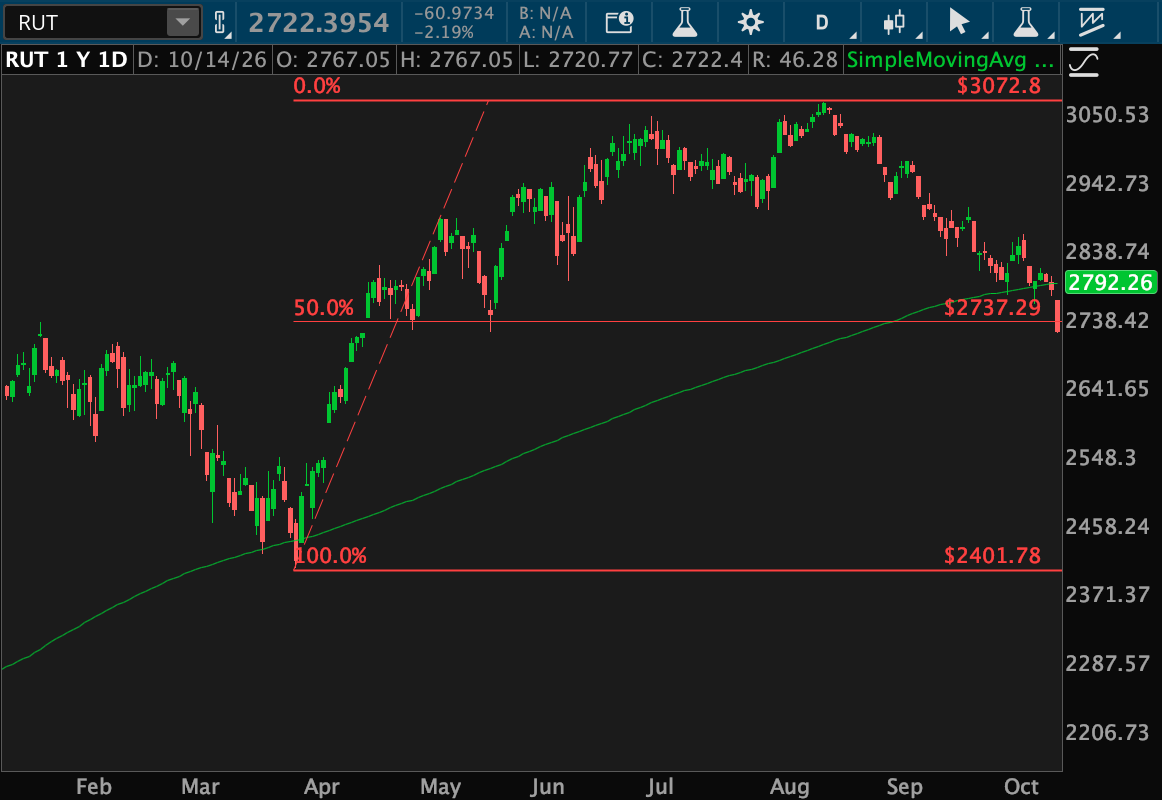
- The most concerning chart among the majors is the small-cap Russell 2000® (RUT), which closed below its 200-day simple moving average this week for the first time since March. As of late Wednesday, 12% of Russell 2000 components traded at 52-week lows.
More insights from Schwab

Corporate bond check: While yields for corporate bonds are currently high, credit spreads—or their premium to Treasury yields—are low, suggesting investors aren't rewarded for the extra risk. However, corporate balance sheets are generally in good shape, perhaps providing reasons to remain invested, said Collin Martin, head of fixed income research and strategy at SCFR.
Tracking short interest: The latest Schwab Short Interest Monitor features a mix of firms from tech, pharmaceutical, retail, and other areas of the market.
Don't put off estate planning: Several recent celebrity cases served as public reminders about the importance of handling estate planning in advance. Learn more about steps to take in our latest estate planning article.
Learn to buy and sell crypto: Our new crypto trading video series offers step-by-step instructions for buying and selling cryptocurrencies on Schwab.com, Schwab Mobile, thinkorswim desktop, and on the Android and iOS thinkorswim apps. There's even a new video for crypto beginners (otherwise known as n00bs).
Chart of the day
Data source: CME Group. Chart source: thinkorswim® platform.
Past performance is no guarantee of future results.
For illustrative purposes only.
The S&P 500 bull market (SPX—candlesticks) turned four yesterday, seen in this four-year chart. Since the October 12, 2022 low, the benchmark index has more than doubled, roughly 22% annualized, despite a bond market selloff, the fastest Fed hiking cycle in four decades, war, hot inflation, and deficit worries. The tech-heavy Nasdaq-100® (NDX—blue line) has outpaced the SPX during that time, but the S&P 500 Equal Weight Index (SPXEW—purple line) is well behind. It measures every component equally rather than by market capitalization.
The week ahead
October 16: Expected earnings from Travelers (TRV) and Truist (TFC), and industrial production for September.
October 19: Expected earnings from Fifth Third (FITB).
October 20: Expected earnings from GE Aerospace (CE), RTX (RTX), 3M (MMM), General Motors (GM), Northrop Grumman (NOC), Halliburton (HAL), Netflix (NFLX), Intuitive Surgical (ISRG), Chubb (CB), Capital One (COF), and United Airlines (UAL), and September housing starts and building permits.
October 21: Expected earnings from Meta Platforms (META), Tesla (TSLA), Lam Research (LRCX), Texas Instruments (TXN), Philip Morris (PM), Thermo Fisher Scientific (TMO), Abbott Laboratories (ABT), NextEra Energy (NEE), Danaher (DHR), AT&T (T), CME Group (CME), Vertiv (VRT), Elevance Health (ELV), Moody's (MCO), SAP SE (SAP), IBM (IBM), CSX (CSX), United Rentals (URI), and Teradyne (TER).
October 22: Expected earnings from Procter & Gamble (PG), Union Pacific (UNP), Valero Energy (VLO), Blackstone (BX), Lockheed Martin (LMT), Spotify (SPOT), Barclays (BCS), Comcast (CMCSA), Norfolk Southern (NSC), Honeywell (HON), Western Digital (WDC), Newmont (NEM), Bloom Energy (BE), VeriSign (VRSN), and Deckers Outdoor (DECK).