Lay the groundwork: How to prepare for a future M&A deal as an RIA
Part two of our M&A activation series for RIAs
Key Points
Assess how ready you are to begin M&A activity. Evaluating your firm now allows you to shore up any issues before you start talking to prospective partners.
Valuation is highly nuanced. Focus on value drivers to make your firm more attractive to prospective partners.
You can prepare for due diligence even before you have a potential partner. Work ahead to identify your firm's must-haves and red flags.
Preparing for M&A starts with understanding how ready your firm is, what drives its value, and what it will take to evaluate the right partner. As momentum builds, this is where strategy turns into practical prep.
In part one of this series, we talked about setting goals and laying the strategic groundwork for M&A. Now it's time to connect your priorities with the nuts and bolts of getting a deal done.
"Firms that take the time to understand the fundamentals of dealmaking and align their approach with their goals are not only better prepared to navigate the pre-deal process, but also better positioned to manage integration and effectively capture synergies once a deal is complete," says Lisa Salvi, managing director of Business Consulting and Education at Schwab Advisor Services.
If you're eager to talk to potential partners, hold on to that feeling (we'll get there in part 3). First, let's focus on getting your house in order.
Assess your readiness
Before pursuing M&A, assess whether your firm can support the operational and organizational demands of a deal. Even a strong opportunity can fall short if your firm is not positioned to execute and integrate effectively.
"Sometimes, when one firm buys another, it's like a snake swallowing a chair—they just can't digest it," says Dave Barton, vice chairman and M&A deal team leader at Mercer Advisors.
To think through what "ready" really means, consider a few questions:
People Are your firm's culture and management practices optimized to bring on—or integrate with—another team? Do you have the operational strength and leadership to merge with another firm and staff? Do you have the people power to make a move? Would your compensation, benefits, and development opportunities be attractive to a potential partner (particularly if you're a buyer)? Will you compensate people for extra time put into closing a deal and making the transition?
Processes Are your firm's processes clear and repeatable? Do you have detailed workflows that help staff be more efficient? Are you prepared to find, vet, and work with potential partners?
Technology How user-friendly is your technology—both for staff and clients? Is your technology ready to help you merge with another business? Do you expect your technology to be adopted by another firm or are you looking to your partner firm to bring new tech to the table? Do you have strong cybersecurity protocols?
Partners What external providers will you need to engage as a deal progresses? Firms often work with M&A attorneys, investment bankers and/or M&A advisors, sourcing partners, financing partners, and external accounting firms.
Presence Does your online presence accurately reflect your firm and value proposition to potential M&A partners? What do your regulatory and compliance profiles say about you? Do you have a social media presence?
If any of these areas are uncertain or can be improved, now's the time to do it. You want to enter M&A conversations feeling confident that you're ready to move when the right deal emerges.
Understand valuation
Valuation helps clarify both what your firm is worth and which factors can strengthen or weaken a potential deal. But it is only one part of how a deal is assessed. Buyers and sellers are both looking for synergies—opportunities for the two firms to be worth more together.
There are a few different valuation methodologies and all of them require careful considerations. What's important is to be realistic about your firm's strengths and weaknesses so that you can better understand what type of deal is possible.
As you consider the value of your firm, focus on value drivers—what can positively or negatively affect the value of your firm in the eyes of a potential partner. Common value drivers include:
Growth: A track record of consistent growth that's spread across the team and driven by firm processes.
Risk factors: Ongoing issues that can lower profits or harm the business, including low client satisfaction, a high concentration of revenue from one client or advisor, or recent compliance missteps.
Scale: Predictable cash flow and operational stability that show the firm is being run efficiently.
Control may also be a factor in valuation. In general, the more control the selling firm wants to retain, the lower the valuation.
Do your due diligence
Due diligence helps RIA firms confirm alignment, uncover risks, and confirm whether a potential partner is truly the right fit. There can be real negative consequences to a superficial due diligence process. That's why many firms kick off due diligence before they have a potential partner. Starting early gives you a chance to compile a robust list of the information you'd like from potential partners so that you're sure the firm you're doing business with lines up with your expectations and understandings.
Also, you may wish to consider how your firm will look to potential partners through the lens of due diligence. If you see something that might raise a red flag, now is a great time to address it internally.
"Well-documented processes are important to have. However, as you're going through the due diligence process, it's important to not solely rely on the process," says Jeff Dekko, CEO of Wealth Enhancement Group. "Take a step back to stop and think critically to make sure you aren't missing a larger issue."
Deal documentation
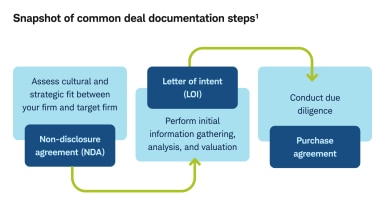
You can begin creating deal documentation templates before you have a ready partner. Working ahead to engage legal counsel can help you establish what's essential in a deal and better prepare you for issues as they arise.
Preparing for due diligence might include:
Requesting items that help you confirm that the other firm is prepared to support your M&A goals.
Understanding the risks you want to manage.
Clarifying the value of potential synergies.
Thinking through the integration process.
Understanding how clients and staff will be affected by the deal and adding to your request list additional items that could help smooth integration when you reach that stage.
Many firms manage due diligence by aligning internal subject matter experts (SMEs) with their area(s) of expertise.
Due diligence can feel high-pressure because it is. This is typically the last chance you get to uncover potential issues and identify obstacles to a smooth integration. That's why it can be so helpful to prepare for this step well before you need it. If you set up your request list, your reviewers, and your process now, you can feel more confident when the time for due diligence arrives.
Find your fit
The right M&A deal is not always the highest offer. It's what best aligns with your firm's goals, culture, and long-term vision. For some firms, this may mean taking the biggest offer, but not always. Deal structure, cultural alignment, and future roles for you and your team also may carry significant weight.
"About half the time our clients will take the highest offer—which means that in the other half of deals, they don't," says David DeVoe, founder and CEO of DeVoe & Company.
The right fit can take many forms, but finding it requires clear priorities and disciplined preparation.
Have questions about M&A or just want to know more about how Schwab supports RIAs? Let's talk about it. Our experienced team is ready to help you think through your opportunities. Let's talk.
Thought leadership from Schwab Advisor Services is designed to capture a moment in time. Firm information, including names, team members, AUM, and many other factors, may have changed since publication. Although these details are fluid, we believe that many of the insights and experiences shared by the advisors cited in this piece are evergreen and contain practical value for advisors today.
Advisors mentioned are clients of Schwab and were not compensated for their comments. The experiences described may not be the experiences of all clients and are not a guarantee of future performance or success.
For financial professional/advisor use only - not for further distribution.
For general informational and educational purposes only.
These materials are provided as a convenience. They are provided entirely as is, without warranties of any kind. Use of the materials is at your own sole risk and liability.