From access to advocacy: How RIAs are shaping the next generation of talent

As the RIA industry evolves, so does its approach to talent. Firms are increasingly moving beyond passive hiring toward something more intentional: building awareness, creating access, and genuinely investing in the people coming up behind them. But what does that actually look like from the perspective of someone just getting started?
We asked Marvin Davies IV, a CFP® professional at Focus Financial Partners, about discovering the industry, navigating early barriers, and what it takes for firms to move from simply hiring talent to truly developing it. As a recent Ohio State graduate, former D1 collegiate football player, Schwab RIATA Student Scholarship recipient, and IMPACT conference attendee, he brings a fresh perspective shaped by firsthand experience.
Awareness: Discovering the profession
Marvin's introduction to investing started when a family member helped him open a Roth IRA on his 16th birthday. He put money into company names he recognized and was interested in, but having an account didn't mean having a plan, or truly understanding how investment vehicles could shape his financial future.
It wasn't until college that investing started to feel like more than a passing interest. One day in the locker room, what started as a typical conversation between teammates and coaches turned into a lively debate about investment strategies—who was buying what, which cryptocurrency was about to take off, and why. It quickly became clear that most of the ideas being tossed around weren't grounded in research or informed advice. They were based on whatever was trending online.
That was Marvin's lightbulb moment. He didn't just want to understand investing for himself; he wanted to be someone who could provide sound financial guidance and help people make real progress toward their financial goals.
He started doing his own research, but it took more than curiosity to build real knowledge. Marvin committed to the finance track at Ohio State's Fischer College of Business, signed up for coursework outside his comfort zones, and began to see just how broad (and interesting!) the financial services industry really was. What set him apart early on wasn't just knowing what to invest in but learning how to talk to people about their money in a way that was grounded in real education.
The independent advisory space was where it all came together. Financial advising offered Marvin a career path where Marvin could base his work in knowledge while building the confidence to back up his thinking with genuine expertise.
That early introduction to investing reshaped his trajectory, and it's something he thinks about when encouraging others to explore the field. His advice for students early in their financial services journey: start with topics you're genuinely curious about, seek out mentorship, try new classes, and show up to networking events. The nuances of financial services and its many career pathways become much clearer when you're actively engaged and eager to learn.
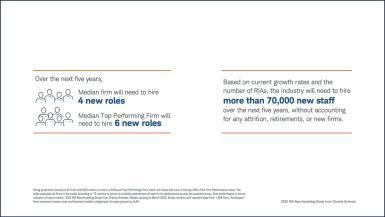
Schwab insights: According to Schwab's 2025 RIA Benchmarking Study, the RIA industry will need to hire more than 70,000 new entrants over the next five years to sustain growth, and that doesn't account for personnel turnover or succession. A third of independent advisory firms are already building relationships with accredited colleges and universities to find talent early.
- Next-Gen leaders: Say yes to the thing that sounds unfamiliar—a new class, a networking event, an informational interview. The best career paths are usually the ones you didn't know existed.
- Firms of the future: Build relationships with colleges and universities early, not just career fairs, but guest lectures, mentorship programs, and internships that give students a real taste of advisory work.
Access: Building your own path
Marvin leaned on his network to explore what was out there and ultimately landed a role after graduation that aligned with his priorities. Since joining his firm two years ago, he's found early success and a deepening commitment to growing within the industry.
But it hasn't all been smooth sailing. One of the most common hurdles he's faced is proving just how much he can bring to the table in a short amount of time. Clients (both current and prospective) tend to gravitate toward advisors with longer track records, which means newer advisors have to stay committed to demonstrating their value. Every early conversation can feel like an interview, he says, but don't let that get in the way of a great partnership. Money is emotional, so it's natural for people to feel personally invested in who's managing it.
Rather than seeing his age as a barrier, Marvin views it as an opportunity to show he's in it for the long game. The advisory profession is built on lasting relationships and long-term thinking, and as the industry continues to evolve, there's room for advisors at every stage to contribute meaningfully. For those just getting started, he says it's about building credibility one conversation at a time.
Marvin also points to LinkedIn as a seriously underutilized tool for anyone looking to break into the space. He sees it as one of the most accessible ways to find mentors—inside or outside your company—build community, follow firms you admire, and start real relationships by starting real conversations. What sets it apart from other platforms, he says, is the ability to engage directly: ask questions, share your perspective, and learn from people already doing the work.
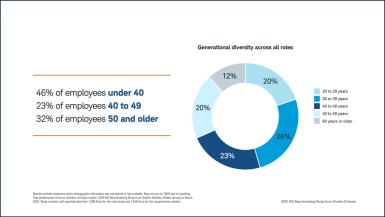
Schwab insights: The industry is getting younger. According to Schwab's 2025 Compensation Report, 46% of RIA professionals are under 40, 23% are 40 to 49, and 32% are 50 or over.
- Next-Gen leaders: Don't be discouraged by where you are in your career; there is real opportunity out there. LinkedIn is one of the easiest places to start. Follow firms you admire, engage with their content, and don't be afraid to introduce yourself to people already doing the work.
- Firms of the future: Access goes both ways. Firms that show up on the platform and respond to early-career outreach are more likely to connect with talent that's the right fit.
Amplification: Supporting and elevating next-gen talent
Marvin's current boss played a pivotal role in his early development by helping him get established, including him in conversations that created real opportunities, and advocating for him when it mattered most. That kind of active involvement, Marvin says, is what turns a first job into a real career.
It's also where the industry has the most room to grow. Marvin notes that firms have gotten stronger at identifying young talent, but where things tend to fall short is what comes after the hire. Without a real plan for growth—clear benchmarks, the right resources, ongoing support—that early momentum can stall.
What makes the difference is structured, intentional support: workshops that help newer advisors find their voice and differentiate themselves, clear roadmaps for advancement, and senior advisors who actively champion the people coming up behind them.
For Marvin, it comes down to visibility and follow-through. Small gestures go a long way; a LinkedIn post announcing a new hire, an email introduction to a client, an invitation to an industry event. When senior advisors take the time to invest in newer colleagues, it gives emerging advisors both optimism and credibility, while creating something tangible to work toward.
Marvin is candid about his own learning curve, too. When he earned his CFP® designation, he expected to feel like the hard part was over. He even had a celebration planned! Instead, he was struck by how much he still had left to learn. It's a disarmingly honest admission, and exactly the kind of self-awareness that builds trust with clients and colleagues alike.
The hardest-working advisors will show up and do the work, he says, but even the strongest young talent needs clear, attainable goals to work toward. Firms that create clear advancement timelines, offer intentional development opportunities, and give younger advisors meaningful exposure will be best positioned to attract and retain the next generation of talent.
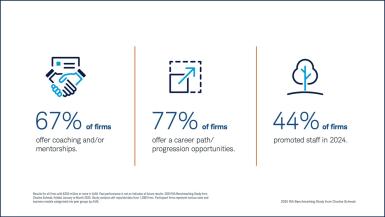
Schwab insights: The commitment to developing talent is increasingly being matched with action. According to Schwab's 2025 RIA Benchmarking Study, 67% of firms offer coaching and/or mentorships, and 77% offer career pathing and/or progression opportunities.
- Next-Gen leaders: Look for firms that walk the talk. The ones with real development plans, not just promises. That kind of intentional investment is a signal you're joining a team, not just filling a seat.
- Firms of the future: Make the investment visible from day one. Formalize development plans, map out clear advancement pathways, and share them with new hires early. When people can see where they're headed, they're far more likely to stay and grow with you.
What you can do next
- Looking to strengthen your talent strategy? Look no further. Schwab's talent management resources and programs help RIA firms attract, develop, and retain great people.
- Curious about how Schwab helps RIAs? Wealth services, technology, and business support are just the beginning. Whether you're exploring independence or considering a custodian swap, we're here to help you take your next step.
About the 2025 RIA Benchmarking Study from Charles Schwab
Schwab designed the RIA Benchmarking Study to capture insights in the RIA industry based on survey responses from individual firms. The 2025 study provides information on topics such as asset and revenue growth, sources of new clients, products and pricing, staffing, compensation, marketing, technology, and financial performance. Fielded from January to March 2025, the study contains self-reported data from 1,288 firms that custody their assets with Schwab and represents over $2.4 trillion in assets under management, making this the leading study in the RIA industry. Schwab did not independently verify or validate the self-reported information. Participant firms represent various sizes and business models. The study is part of Schwab Business Consulting and Education, a practice management offering for RIAs. Grounded in the best practices of leading independent advisory firms, Business Consulting and Education provides insight, guidance, tools, and resources to help RIAs strategically manage and grow their firms.
Past performance is not an indicator of future results.