2026 RIA Benchmarking Study: How RIA firms are growing

What this year's benchmarking study tells us about how firms pursue growth
Key Points
-
- Schwab's 2026 RIA Benchmarking Study shows that (once again) Top Performing Firms1 demonstrate a repeatable path to organic growth.
-
- Across firms of all sizes, stronger organic growth is associated with clear processes and consistent execution.
-
- The study suggests that firms that plan and document processes more consistently tend to see higher rates of growth.
Schwab's 2026 RIA Benchmarking Study shows that RIA firms with stronger organic growth tend to pair clear strategy with disciplined execution. In fact, Top Performing Firms stand out not just for their growth strategies, but for how they operate: they are more likely to document referral plans and goals for both clients and business partners, as well as have a documented ideal client persona, client value proposition and marketing plan.
Now in its 20th year, our RIA Benchmarking Study includes insights from 1,236 firms. What two decades of data have shown is there are clear lessons that firms can implement right now. This year's study reinforces that firm fundamentals are a difference-maker, contributing significantly to organic growth and greater growth potential.
"Twenty years of benchmarking data point to a clear conclusion," says Lisa Salvi, managing director of Business Consulting and Education at Schwab Advisor Services, "Firms that pair strategic clarity with disciplined execution are better positioned to achieve stronger organic growth. The firms that take the time to put core growth strategies in place create a compounding effect over time, building momentum that can accelerate growth year after year."
Let's look at what the data shows and a few practical lessons that can help your firm build momentum for the years ahead.
Growth strategies of Top Performing Firms
Organic growth remains a major driver of firm performance, and the strongest firms appear to pursue it more intentionally. In 2025, firms under $250 million AUM grew their assets by 19.6% and larger firms by 16.6%. Investment performance was certainly a factor in this remarkable growth, but net asset flows also were major contributors. In fact, net asset flows accounted for 7.2% of AUM growth among smaller firms and 4.8% among larger firms.
The difference is clearer among Top Performing Firms. In 2025, these firms grew 25.4%, with 12.9% in net new asset flows. Top Performing Firms captured 2.8 times more assets from new clients and 4.2 times more from existing relationships compared with all other firms.
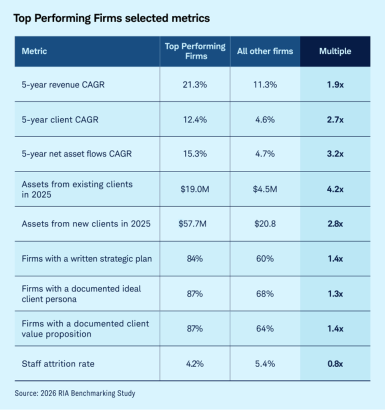
What's one factor that helps Top Performing Firms' organic growth standouts? Business discipline.
Top Performing Firms are more likely to have developed an ideal client persona, a client value proposition, and a marketing plan compared to all other firms.
They also track and manage client acquisition. More than 70% of Top Performing Firms track general inquiries from prospects compared with 58% of all other firms, and 85% track the source of inquiries (compared with 71% of all other firms), allowing them to understand where high-quality referrals are coming from and adjust their referral strategy to maximize the value of those sources.
This combination of planning and tracking helps Top Performing Firms more efficiently target prospects and increases their odds of converting those prospects into clients.
How firms are using AI to improve efficiency
A majority of RIA firms already use artificial intelligence (AI) for everyday administrative tasks and more firms are testing strategic uses.
AI is increasingly used for generating marketing content, drafting client communications, sourcing images, and supporting administrative work like note taking. These low-barrier approaches are common at both Top Performing Firms and other firms.
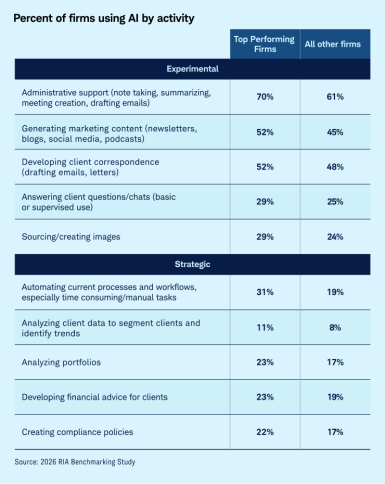
However, Top Performing Firms are more likely to use AI for more strategic efforts to improve efficiency, consistency, and scalability. As you can see in the chart above, Top Performing Firms use AI to automate time-consuming and manual workflows 31% of the time, versus 19% of all other firms, signaling a possible shift toward AI that reduces friction in essential systems.
Recruiting is another emerging use case for AI. Firms report that they've used AI for writing job descriptions (47%), developing interview questions (35%), sourcing candidates (12%), and screening résumés (12%). Early signs point to significant time savings, allowing firms to more actively recruit future leaders and the next generation of RIA talent.
How RIAs add capabilities at scale
As client needs grow more complex, many RIA firms are expanding their capabilities, but adding more products and services does not guarantee growth.
Pledged asset lines (PALs) are now offered by 67% of firms and 61% offer alternative investments. Concentrated stock position solutions (49%) and options trading (35%) also have emerged as common strategies for advisors. Many of these firms are taking advantage of the wealth services Schwab offers right in the platforms and workflows advisors already use.
This expansion of wealth services beyond traditional portfolio management can help firms differentiate in a crowded marketplace but these solutions also require additional oversight, specialized expertise, and more complex compliance and risk management processes. Firms that operate efficiently will be more likely to use new capabilities to help them grow and scale.
Why documentation supports growth, succession, and talent management
Whether a firm is planning for succession, evaluating strategic partnerships, considering an acquisition, or preparing for leadership changes, strong documentation can help firms move from reactive decision-making to a more intentional transition strategy. Clear processes make it easier to understand how a firm operates, where responsibilities sit, and what needs to be aligned before ownership, or team changes take place.
As planning shifts to transition, documentation makes integrating a new team or joining an existing firm much easier. When both sides of the deal can see how the other firm works, it can help each firm evaluate whether the other is a good fit and gives everyone involved time to sort out differences before a deal is final.
That same need for clarity extends to talent management. The presence of documented processes within a firm's talent strategy is one of the clearest signals that the firm is managing growth with intention rather than improvisation. Whether a firm is integrating teams, preparing future leaders, or scaling day-to-day operations, documented talent processes help turn individual knowledge into repeatable practices. Top Performing Firms are ahead of the pack in all areas of documentation with 63% reporting a documented training and development process (versus 48% for other firms), 74% indicating a documented process for compensation, incentives, and benefits (versus 59%), and 70% documenting performance management, including employee reviews (versus 56%).
Bottom line: Documentation is about more than getting plans on paper. It creates a foundation for discipline and consistency that can help firms scale, navigate transitions, and develop people.
Dig into what matters to you
The 2026 RIA Benchmarking Study offers more than just headlines. It provides a wealth of data, especially for participants. Every participating firm receives an interactive dashboard that shows the firm's results and offers comparisons with similar firms. Participants can also sort findings across multiple comparison groups to better understand current performance and future opportunities.
Even if you didn't participate this year, you can still explore more key findings from the RIA Benchmarking Study to see how firms are approaching growth, efficiency, and scale.
What you can do next
- If you're interested in taking part in the next RIA Benchmarking Study, talk to your Schwab team or visit our benchmarking page to learn more.
- Curious about how Schwab helps RIAs? Wealth services, technology, and business support are just the beginning. Whether you're exploring independence or considering a custodian swap, we're here to help you take your next step.
1. Top Performing Firms are those that rank in the top 20% of the Firm Performance Index. The index evaluates all firms in the study according to 15 metrics to arrive at a holistic assessment of each firm's performance across key business areas.
About the 2026 RIA Benchmarking Study from Charles Schwab
Schwab designed the RIA Benchmarking Study to capture insights in the RIA industry based on survey responses from individual firms. The 2026 study provides information on topics such as asset and revenue growth, sources of new clients, products and pricing, staffing, compensation, marketing, technology, and financial performance. Fielded from January to March 2026, the study contains self-reported data from 1,236 firms that custody their assets with Schwab and represents over $2.5 trillion in assets under management, making this the leading study in the RIA industry. Schwab did not independently verify or validate the self-reported information. Participant firms represent various sizes and business models. The study is part of Schwab Business Consulting and Education, a practice management offering for RIAs. Grounded in the best practices of leading independent advisory firms, Business Consulting and Education provides insight, guidance, tools, and resources to help RIAs strategically manage and grow their firms.
Past performance is not an indicator of future results.
The Firm Performance Index evaluates firms in the study according to 15 metrics that align with the Guiding Principles for Advisory Firm Success, to arrive at a holistic assessment of each firm's performance across key business areas. It provides comprehensive comparisons for all firms participating in the study, not just within a peer group. The metrics in the Firm Performance Index measure growth in clients, assets and revenue; client attrition; staff attrition; operating margin; time spent on client service; time spent on operations; standardized workflows; written strategic plan and succession plan; and ideal client persona and client value proposition. The Firm Performance Index is calculated among all firms in the study without regard to assets under management or firm type. Firms that rank in the top 20% of the index are included in the Top Performing Firms.