Geopolitical Uncertainty and Your Portfolio

The past year has seen no shortage of worrying developments on the international stage: sweeping U.S. tariffs; the removal of the president of Venezuela; armed conflicts in Gaza, Iran, and Ukraine—the list goes on.
To be sure, geopolitical shocks typically jolt the market—yet, historically, many of these disruptions have been surprisingly short-lived, often lasting less than a year.
Shock absorber
The S&P 500® Index bounced back from most major geopolitical events of the past 40 years within 12 months.
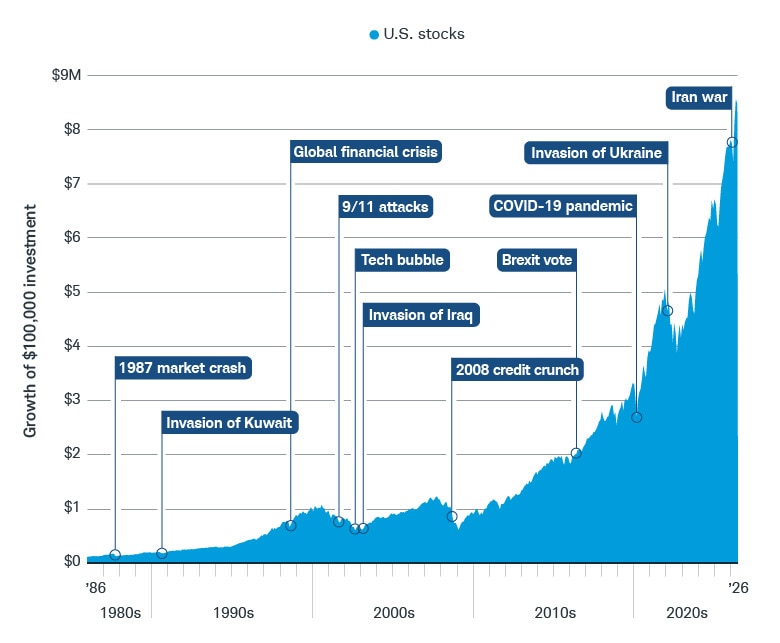
Source: Schwab Center for Financial Research with data provided by Morningstar, Inc.
Data is from 01/01/1986 to 06/30/2026. The chart illustrates the growth of $100,000 invested in a fund that tracks the S&P 500 Total Return Index. For illustrative purposes only.
A changing landscape
That said, two factors suggest that recent major geopolitical events could buck this trend:
1. Global realignment
Driven by evolving U.S. economic policies, many countries are reducing their dependence on the U.S. For instance, the EU and India have finalized a comprehensive free-trade deal, while Canada and China have negotiated tariff reductions on agricultural products and electric vehicles. Long-standing U.S. trade partners like the U.K. and South Korea are also willing to reset economic relations with China.
This realignment extends to defense and energy. As the U.S. reduces its military presence abroad, Germany, Australia, and Japan have significantly increased their military budgets. The war in Iran and the resulting blockage of the Strait of Hormuz have prompted Europe to accelerate its shift toward domestically produced clean energy. Even the United Arab Emirates officially withdrew from the Organization of the Petroleum Exporting Countries (OPEC) in May, citing reassessment of the threats it faces and prioritization of its national interests.
This global fragmentation may pose risks to corporate profitability. Countries could adopt greater protectionist trade policies that can lead to higher overall costs for affected companies and limit access to markets. Additionally, oil price volatility is unlikely to subside in the long term, and the risk premiums that financial markets price on supply disruptions due to the Iran conflict could widen.
2. Persistent inflation
U.S. consumer prices appeared to be stabilizing before the start of the war in Iran, but the resulting surge in the price of oil—which in turn pushed up food, manufacturing, and shipping costs—quickly reversed this progress. These knock-on effects, where businesses pass on rising costs to consumers, can elevate price levels for up to two years.1 This is sure to complicate Federal Reserve interest rate policy.
At the start of 2026, the market was pricing in multiple rate cuts; today, CME FedWatch data shows traders now see a rate hike as more likely than a rate cut this year.2 Consequently, Treasury yields have been climbing as inflation fears grow, eroding their traditional role as a safe haven asset during times of geopolitical turmoil.
The outlook for the dollar also remains in limbo. Higher U.S. Treasury yields and the hawkish shift from the Fed could attract capital into dollar-denominated assets; however, if other central banks hike rates to fight inflation while the Fed holds rather than hikes, it could have the opposite effect.
Adjusting for uncertainty
If you're worried about the lingering impact of the current geopolitical ripples on your investments, there are some steps you can take to help bolster your portfolio and reduce your risk at the margins.
- Bonds: With inflation driving up bond yields, you might consider adding exposure to:
- Corporate bonds: Despite geopolitical uncertainty and low relative yields, investors can consider investment-grade and high-yield corporate bonds, depending on their risk tolerance. A resilient economy and strong corporate earnings support the case to take a little risk in corporate bonds today, but default risk remains elevated with the lowest-rated parts of the market, so investors should be cognizant of the underlying credit ratings of any corporate bond investment.
- Treasury inflation-protected securities (TIPS): Like traditional Treasury bonds, TIPS are backed by the full faith and credit of the U.S. government. However, their principal values are indexed to the Consumer Price Index, meaning their value and coupon payments rise as inflation does.
In both cases, it makes sense to prioritize short- and intermediate-term maturities, as longer-term bonds are more susceptible to price declines due to interest rate changes.
- Stocks: Geopolitical risks and the reordering of traditional global partnerships could have far-reaching effects on securities markets. Examine your portfolio mix and make any necessary adjustments to these allocations:
- International developed-market stocks: At the very least, make sure your equity exposure to non-U.S. developed markets matches your target allocation. The bull run for U.S. stocks in recent years has left many portfolios underweighted to international, which could become a bigger issue if the world becomes less U.S. centric.
- Emerging markets: Developing countries carry more risk because they're smaller and have greater sensitivity to external shocks. However, some are likely to benefit from the realignment of trading alliances and supply chains.
- Actively managed funds: They cost more than their index-based counterparts, but at times of higher uncertainty, the fees could be worth it. Fund managers keep a close eye on the markets in which they invest and adjust their holdings accordingly. That could come in handy at a time when winners and losers are emerging among regions and sectors due to policy changes.
Above all, don't discount the importance of diversification; it's a foundational investing principle for a reason. If this period of uncertainty stretches for months or even years, having exposure to a varied mix of assets may help keep any single shock from having undue influence on your portfolio.
1Harun Alp, Matthew Klepacz, and Akhil Saxena, "Second-Round Effects of Oil Prices on Inflation in the Advanced Foreign Economies," federalreserve.gov, 12/15/2023.
2CME FedWatch, cmegroup.com, 07/06/2026.
Discover more from Onward

Keep reading the latest issue online or view the print edition.
" id="body_disclosure--media_disclosure--318266" >Keep reading the latest issue online or view the print edition.