The fiduciary advantage: Insights from the 2026 Independent Advisor Outlook Study

Key Points
-
- The advisors Schwab surveyed say being a fiduciary is the top benefit of being an RIA.
-
- Advisors are working to build trust through outstanding client service. They believe deeper relationships will lead to more client referrals and greater growth.
-
- Many firms have expanded their wealth services and investment offerings to meet the evolving needs of clients.
-
- Advisors continue to show interest in AI as firms build integrated and flexible tech stacks. They're also looking for a clearer rulebook and practical guardrails to guide how AI is used.
What is the Independent Advisor Outlook Study (IAOS)?
Each year, Schwab Advisor Services surveys registered investment advisors (RIAs) to learn what trends, challenges, and strategies are shaping their firms. The 2026 study surveyed 1,235 independent advisors representing $497 billion in assets under management (AUM).
How advisors work is changing rapidly in the AI era. The latest Schwab Advisor Services Independent Advisor Outlook Study found that integrating AI tools into the firm's workflow was the top investment priority to support firm growth.1 Our 2026 RIA Benchmarking Study found a similar trend, with 83% of participating firms using some form of AI.2
What hasn't changed? The fundamentals of the fiduciary model.
According to the 2026 IAOS, advisors continue to name being a fiduciary as the top benefit of being an RIA. They say that the fiduciary model helps them keep clients' best interests in mind, not force unwanted products on clients, and establish and maintain trust.
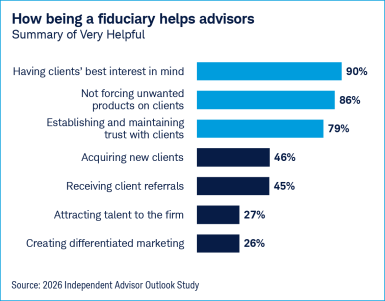
"The fiduciary standard is a differentiator because clients feel it," says Jon Beatty, Head of Schwab Advisor Services. "When someone knows you are putting their interests first, it changes the relationship."
This year's IAOS asked over 1,000 advisors about their perspectives on growth, wealth services, AI, and more. What emerged is a portrait of RIAs who are embracing what's new without losing the values that set them apart.
Growth goes deeper than AUM
Advisors will always have their eyes on AUM, but they understand that making this one number go up is only part of their story.
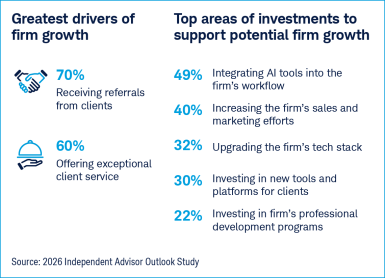
More than half of advisors measure growth through their client count and 40% track growth through AUM per client household. Nearly half of firms are also growing via client referrals, successfully translating client satisfaction and trust into growth.
To support this relationship-driven growth, firms are focusing their investments on improving workflows, sales and marketing, and tech stack upgrades.
RIA firms expand wealth solutions to meet client needs
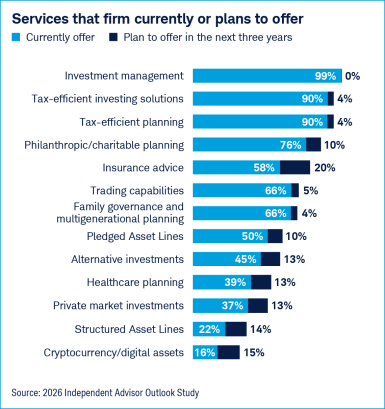
Wealth management is changing. More firms are offering services and products that go beyond wealth management.
Most firms now offer tax-efficient solutions, tax-efficient planning, and charitable planning. Many are also expanding trading capabilities, offering pledged asset lines, and alternative investments.
Among the firms that offer alternative investments, real estate and private equity are most common. A little over a third of firms offer private market investments, and 13% more say they will be offering these investments within the next three years.
"Advisors are expanding what they offer," says Jalina Kerr, Head of Advisor Experience at Schwab. "The advisors doing this well aren't just adding options, they're taking the time to help clients truly understand them."
Technology that's integrated by design and human by intent
When it comes to RIA tech stacks, most firms favor technology that combines integration with flexibility. Among advisors who prefer an open architecture or mixed approach, over half say they want access to "best-of-breed" products, and nearly as many say they want more ability to customize while also avoiding vendor lock-in.
One big reason not to commit too fully to one vendor is how quickly AI is changing. Will today's AI tools serve tomorrow's needs? It's too early to know.
"The firms that thrive will be intentional about where AI can make the most impact on their business, without taking away what matters most—the advisor client relationship," says Alison Dooher, Head of AI at Schwab Advisor Services.
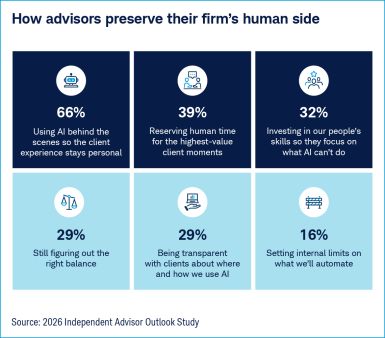
Advisors expect AI to have the greatest impact by reducing time spent on administrative tasks, improving scalability, and improving the quality of client communications. Agentic AI that can operate independently is still at an early stage (only 7% of advisors use it currently), but as advisor knowledge and sophistication grow, there will be more opportunity to see the potential for putting AI to work in the background while advisors spend more of their valuable time with clients. In fact, 66% expect to keep AI behind the scenes so the client experience remains personal.
And while many advisors are optimistic about what AI can and will do for their firms, they are calling for a stronger industry voice. AI regulation and guidance is the top area where RIAs want industry advocacy, and 68% of firms want standards and guidelines that are easy and clear to understand.
What advisors stand for hasn't changed
Advisors are adding capabilities and putting AI to work, but the client relationship remains the heart of the RIA business. This commitment to putting clients first is why clients trust their advisors and RIA growth continues to outpace the broader wealth management industry.3
The 2026 Independent Advisor Outlook Study shows that, while advisors adopt new technology, invest in new offerings, and work toward growth in new ways, what they stand for hasn't changed.
What you can do next
- Dive deeper into the 2026 Independent Advisor Outlook Study results to learn more about the trends and perspectives shaping the RIA industry.
- Curious about how Schwab helps RIAs? Wealth services, technology, and business support are just the beginning. Whether you're exploring independence or considering a custodian swap, we're here to help you take your next step.
1. Schwab Advisor Services Independent Advisor Outlook Study, October 2026.
2. About the 2026 RIA Benchmarking Study from Charles Schwab
Schwab designed the RIA Benchmarking Study to capture insights in the RIA industry based on survey responses from individual firms. The 2026 study provides information on topics such as asset and revenue growth, sources of new clients, products and pricing, staffing, compensation, marketing, technology, and financial performance. Fielded from January to March 2026, the study contains self-reported data from 1,236 firms that custody their assets with Schwab and represents over $2.5 trillion in assets under management, making this the leading study in the RIA industry. Schwab did not independently verify or validate the self-reported information. Participant firms represent various sizes and business models. The study is part of Schwab Business Consulting and Education, a practice management offering for RIAs. Grounded in the best practices of leading independent advisory firms, Business Consulting and Education provides insight, guidance, tools, and resources to help RIAs strategically manage and grow their firms.
Past performance is not an indicator of future results.
3. The RIA Marketplace in 2026: Solving for Scale, Growth, and the Enterprise Operating Model, Cerulli Associates, April 8, 2026, https://www.cerulli.com/webinars/webinar-the-ria-marketplace-in-2026.